गोवर्धन पूजा कथा और विधि
Govardhan Puja Katha and Vidhi
कार्तिक शुक्ल प्रतिपदा की गोवर्धन पूजा — श्रीकृष्ण, इंद्र का क्रोध और गिरिराज की कथा, गोबर के गोवर्धन और अन्नकूट की पूजा विधिGovardhan Puja on Kartik Shukla Pratipada, the day after Diwali: how Krishna lifted the hill against Indra's rain, and how to make and worship the Govardhan of cow dung with the Annakut
2026 मेंIn 2026
मंगलवार, 10 नवंबर 2026Tuesday, 10 November 2026
कार्तिक शुक्ल प्रतिपदा · 12:32 (9 नवंबर 2026) से 14:00 (10 नवंबर 2026) तकKartika Shukla Pratipada · from 12:32 on 9 November 2026 to 14:00 on 10 November 2026
- प्रातःकाल मुहूर्तMorning muhurat
- 06:43 – 08:52
- सायंकाल मुहूर्तEvening muhurat
- 15:17 – 17:26
PDF डाउनलोडDownload PDF
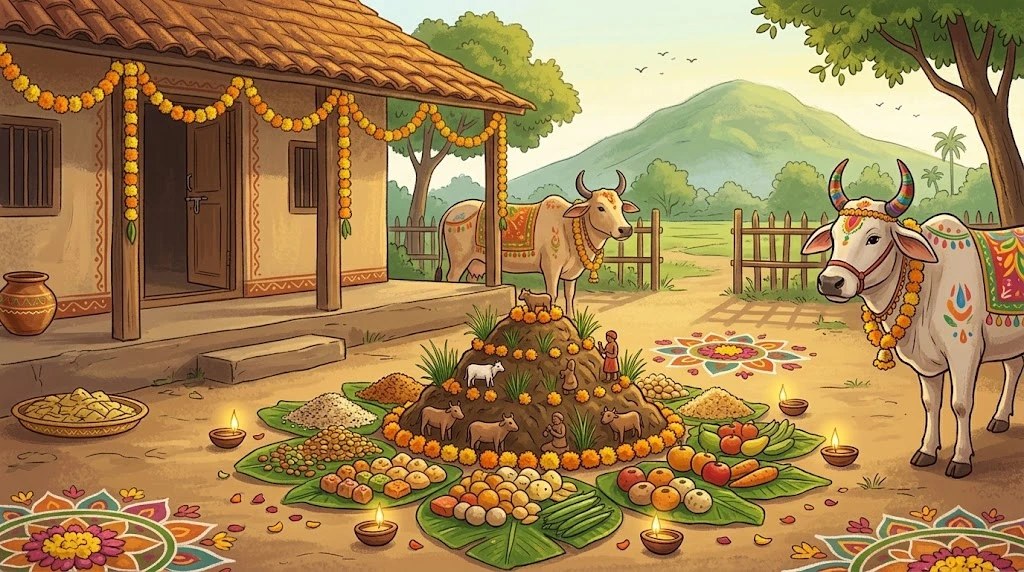
दीपावली के अगले दिन, कार्तिक शुक्ल प्रतिपदा को गोवर्धन पूजा होती है। इसे अन्नकूट भी कहते हैं। इस दिन ब्रज में और देश भर के घरों में गोबर से गिरिराज गोवर्धन की आकृति बनाई जाती है, उसे फूल-पत्तियों से सजाया जाता है, अन्न और सब्ज़ियों का पहाड़ — अन्नकूट — उसके सामने रखा जाता है और गायों की पूजा की जाती है। यह उत्सव श्रीकृष्ण की उस लीला की स्मृति है जिसमें उन्होंने ब्रजवासियों को इंद्र के बदले गोवर्धन पर्वत और अपनी गायों की पूजा करना सिखाया।
गोवर्धन पूजा का संदेश सीधा है — जो हमें रोज़ पालता है, उसी का आदर करो। पर्वत, नदी, गाय, धरती और अन्न देवताओं की तरह दूर नहीं हैं, हमारे पास हैं। श्रीकृष्ण ने यही सिखाया, और जब इंद्र ने क्रोध में ब्रज को डुबाने की कोशिश की, तब उन्होंने सात दिन तक गोवर्धन को अपनी छोटी उँगली पर उठाकर सबकी रक्षा की। नीचे वह कथा है जो इस दिन घरों में पढ़ी जाती है, और उसके बाद पूजा की पूरी विधि।
Govardhan Puja falls on Kartik Shukla Pratipada, the day after Diwali. It is also called Annakut. On this day, in Braj and in homes across the country, a small hill of Govardhan is shaped out of cow dung, decorated with flowers and leaves, a mountain of cooked grain and vegetables (the Annakut) is set before it, and the cows are worshipped. The festival remembers the lila in which Krishna taught the people of Braj to honour the Govardhan hill and their own cows instead of Indra.
The message of Govardhan Puja is simple: honour what feeds you every day. The hill, the river, the cow, the earth and the grain are not distant like the gods; they are right here. Krishna taught this, and when Indra tried in his anger to drown Braj, Krishna held the hill up on his little finger for seven days and sheltered everyone beneath it. Below is the katha read at home on this day, followed by the full method of the puja.
कथाThe story
बहुत पुरानी बात है। ब्रज के गाँवों में हर वर्ष वर्षा के बाद इंद्र का यज्ञ होता था। गोप-गोपियाँ दूध, दही, मक्खन, अन्न और पकवान जुटाते और वर्षा के देवता इंद्र को अर्पित करते, ताकि वे प्रसन्न रहें और अगले वर्ष भी समय पर वर्षा दें। उस वर्ष भी नंद बाबा और ब्रज के बड़े-बूढ़े यज्ञ की तैयारी में लगे थे। बालक कृष्ण ने यह सारी हलचल देखी और पूछा, 'बाबा, इतनी तैयारी किसके लिए हो रही है?'
नंद बाबा ने समझाया, 'लाला, यह इंद्र देव की पूजा है। वे वर्षा करते हैं, वर्षा से घास होती है, घास से गायें पलती हैं और गायों से हम। इसलिए हर वर्ष इंद्र का यज्ञ होता है।' कृष्ण ने मुस्कराकर कहा, 'बाबा, वर्षा करना तो इंद्र का काम है, इसमें वे हम पर कोई कृपा नहीं करते। और हमारी गायें तो गोवर्धन पर चरती हैं — वहीं की घास, वहीं का जल, वहीं की छाया। हमें रोज़ पालने वाले तो गिरिराज गोवर्धन हैं और हमारी गायें हैं। जो हमारे सामने हैं और हमें हर दिन देते हैं, हम उनकी पूजा क्यों न करें?'
बड़े-बूढ़े पहले सकपकाए — इंद्र का यज्ञ तो पुरखों से चला आ रहा था। पर कृष्ण की बात में सच था और उनकी वाणी में ऐसा विश्वास था कि सब मान गए। उस वर्ष यज्ञ की सारी सामग्री गोवर्धन की तलहटी में ले जाई गई। ब्रजवासियों ने पर्वत को जल से स्नान कराया, फूल चढ़ाए, और सारा पकवान — पूरी, खीर, हलवा, दाल-भात, सब्ज़ियाँ, दही, मक्खन — ढेर लगाकर गिरिराज को अर्पित किया। गायों को सजाया, उन्हें तिलक किया और हरी घास खिलाई। फिर सबने पर्वत की परिक्रमा की। कहते हैं, उसी समय कृष्ण ने एक विशाल रूप धरकर गोवर्धन के शिखर से कहा, 'मैं गिरिराज हूँ,' और सारा भोग ग्रहण किया, ताकि ब्रजवासियों का विश्वास पक्का हो जाए।
स्वर्ग में इंद्र को जब यह पता चला तो वे क्रोध से काँप उठे। 'इन ग्वालों की यह हिम्मत! एक बालक के कहने पर मेरा यज्ञ छोड़कर पत्थर के पहाड़ को पूजते हैं!' उन्होंने प्रलय लाने वाले सांवर्तक मेघों को आदेश दिया, 'जाओ, ब्रज को डुबा दो।' आकाश काले बादलों से ढँक गया। बिजली कड़की, आँधी चली, और ऐसी वर्षा हुई जैसी ब्रज ने कभी नहीं देखी थी। पानी घरों में भर गया, यमुना उफन पड़ी, गायें रँभाने लगीं और बच्चे डर से रोने लगे।
ब्रजवासी भागे-भागे कृष्ण के पास आए — 'कन्हैया, तेरे कहने पर हमने इंद्र को छोड़ा, और अब इंद्र हमें डुबा रहा है। अब तू ही बचा!' कृष्ण ने शांत भाव से कहा, 'डरो मत। तुम गिरिराज की शरण में आए हो, गिरिराज तुम्हें बचाएँगे।' वे गोवर्धन के पास गए, और सात वर्ष के उस बालक ने उस विशाल पर्वत को जड़ से उखाड़कर अपने बाएँ हाथ की छोटी उँगली पर ऐसे उठा लिया जैसे कोई बच्चा छतरी उठाता है। 'आओ, सब नीचे आ जाओ — गायें, बछड़े, बूढ़े, बच्चे, सब!'
सारा ब्रज पर्वत के नीचे आ गया। ऊपर इंद्र के मेघ सात दिन और सात रात बरसते रहे, और नीचे एक बूँद भी न टपकी। कृष्ण उँगली पर पर्वत उठाए मुस्कराते रहे। गोप बालक मज़ाक में अपनी लाठियाँ पर्वत के नीचे टिकाने लगे — 'कन्हैया, थक गया होगा, हम सहारा दे रहे हैं!' गोपियाँ उनके मुख की ओर देखती रहीं और भूख-प्यास भूल गईं। सात दिन में किसी को न भूख लगी, न नींद आई — ऐसा था गिरिधारी का आश्रय।
सातवें दिन इंद्र का घमंड टूट गया। उन्होंने समझ लिया कि जिसकी उँगली पर पर्वत टिका है, वह कोई साधारण बालक नहीं — वह स्वयं नारायण हैं, जिनके बल पर इंद्र का पद भी टिका है। मेघ लौट गए, आकाश खुला, सूर्य निकला। कृष्ण ने सबको बाहर निकालकर पर्वत को उसकी जगह रख दिया। तब इंद्र ऐरावत से उतरकर सिर झुकाए कृष्ण के चरणों में आए। कामधेनु ने अपने दूध से और इंद्र ने स्वर्ग की गंगा के जल से कृष्ण का अभिषेक किया। इंद्र ने हाथ जोड़े — 'प्रभु, मैं अपने पद के अहंकार में अंधा हो गया था। मुझे क्षमा करें।' कृष्ण ने क्षमा किया और कहा, 'इंद्र, तुम्हारा घमंड तोड़ने के लिए ही मैंने यह यज्ञ रुकवाया था। जाओ, अपना काम करो, पर यह न भूलो कि पद तुम्हारा है, शक्ति मेरी।' तब से कृष्ण 'गोविंद' और 'गिरिधारी' कहलाए।
ब्रजवासियों ने उस दिन फिर से गोवर्धन को भोग लगाया — और इस बार पहले से भी बड़ा। अन्न का ऐसा पहाड़ लगा कि उसका नाम ही 'अन्नकूट' पड़ गया। तब से हर वर्ष कार्तिक शुक्ल प्रतिपदा को, दीपावली के अगले दिन, गोवर्धन पूजा और अन्नकूट होता है। ब्रज में लोग आज भी गोवर्धन की सात कोस की परिक्रमा करते हैं, और घर-घर में गोबर का गोवर्धन बनाकर उसकी पूजा होती है। कहते हैं, जो इस दिन गिरिराज और गायों की पूजा करता है, उसके घर में अन्न, दूध और धन की कमी नहीं रहती, और श्रीकृष्ण उसकी रक्षा वैसे ही करते हैं जैसे उन्होंने ब्रज की की थी।
This is an old story. In the villages of Braj, a yajna for Indra was held every year once the rains had passed. The cowherds and their wives gathered milk, curd, butter, grain and sweets and offered them to Indra, god of rain, so that he would stay pleased and send the rains on time the next year too. That year as well, Nanda Baba and the elders of Braj were busy preparing the yajna. The boy Krishna watched all the bustle and asked, 'Baba, who is all this preparation for?'
Nanda Baba explained, 'Lala, this is the worship of Indra Dev. He sends the rain, the rain grows the grass, the grass feeds the cows, and the cows feed us. That is why Indra's yajna is held every year.' Krishna smiled and said, 'Baba, sending rain is Indra's job; he does us no favour by it. And our cows graze on Govardhan. Its grass, its water, its shade. The ones who feed us every day are Giriraj Govardhan and our own cows. Why should we not worship those who are right in front of us and give to us every single day?'
The elders were taken aback at first; the yajna for Indra had come down from their forefathers. But there was truth in what Krishna said, and such confidence in his voice, that they all agreed. That year all the materials of the yajna were carried to the foot of Govardhan. The people of Braj bathed the hill with water, offered flowers, and heaped up every dish they had cooked, puris, kheer, halwa, dal and rice, vegetables, curd and butter, as an offering to Giriraj. They decorated the cows, marked them with tilak and fed them fresh grass. Then everyone walked around the hill. It is said that at that moment Krishna took on a vast form and spoke from the summit of Govardhan, 'I am Giriraj,' and accepted the whole offering, so that the faith of the people of Braj would be made firm.
When Indra in heaven learned of this, he shook with rage. 'The nerve of these cowherds! At the word of a child they abandon my yajna and worship a hill of stone!' He commanded the Samvartaka clouds, the clouds of the final deluge, 'Go, drown Braj.' The sky turned black. Lightning cracked, a gale rose, and rain fell such as Braj had never seen. Water filled the houses, the Yamuna swelled over her banks, the cows bellowed and the children cried in fear.
The people of Braj came running to Krishna. 'Kanhaiya, at your word we gave up Indra, and now Indra is drowning us. Only you can save us now!' Krishna said calmly, 'Do not be afraid. You took refuge in Giriraj, and Giriraj will protect you.' He went to Govardhan, and that boy of seven uprooted the great hill and lifted it on the little finger of his left hand as easily as a child lifts an umbrella. 'Come, everyone, come underneath. Cows, calves, the old, the young, all of you!'
All of Braj came in under the hill. Above, Indra's clouds poured for seven days and seven nights; below, not one drop fell. Krishna stood smiling with the hill on his finger. The cowherd boys propped their sticks against the underside of the hill in jest: 'Kanhaiya, you must be tired, we are holding it up for you!' The gopis kept gazing at his face and forgot hunger and thirst. In seven days nobody felt hungry and nobody felt sleepy. Such was the shelter of Giridhari.
On the seventh day Indra's pride broke. He understood that the one holding up a mountain on his finger was no ordinary child: this was Narayana himself, on whose strength even Indra's throne rests. The clouds withdrew, the sky cleared, the sun came out. Krishna brought everyone out and set the hill back in its place. Then Indra climbed down from his elephant Airavata and came, head bowed, to Krishna's feet. The celestial cow Kamadhenu bathed Krishna with her milk and Indra with the water of the heavenly Ganga. Indra folded his hands: 'Lord, the pride of my office blinded me. Forgive me.' Krishna forgave him and said, 'Indra, it was to break that pride that I had this yajna stopped. Go and do your work, but never forget: the office is yours, the power is mine.' From that day Krishna was called Govinda and Giridhari.
That day the people of Braj offered the feast to Govardhan all over again, and this time larger than before. The pile of food was so high that it earned the name Annakut, the mountain of grain. Since then, every year on Kartik Shukla Pratipada, the day after Diwali, Govardhan Puja and Annakut are celebrated. In Braj people still walk the seven-kos parikrama of Govardhan, and in home after home a Govardhan of cow dung is made and worshipped. It is said that whoever worships Giriraj and the cows on this day never lacks grain, milk or wealth in the house, and that Krishna protects them as he once protected Braj.
पूजा विधिHow to perform the puja
सामग्री: ताज़ा गोबर, फूल और पत्तियाँ (गेंदा, तुलसी, और करील या कुश की टहनियाँ), रोली, अक्षत, हल्दी, मौली, धूप, मिट्टी का दीपक और घी, खील-बताशे, रुई की माला, दूध-दही-मक्खन-मिश्री, और अन्नकूट के लिए जितने व्यंजन घर में बन सकें — कढ़ी-चावल, पूरी, मिली-जुली सब्ज़ी, खीर, हलवा, दाल। श्रीकृष्ण या गिरिराज का चित्र साथ रखें।
दीपावली के अगले दिन सुबह स्नान करके आँगन या मुख्य द्वार के पास की ज़मीन साफ करें। गोबर से गोवर्धन की लेटी हुई आकृति बनाएँ — एक लंबी, मनुष्य जैसी आकृति, जिसका सिर, हाथ-पैर और नाभि हो। नाभि के स्थान पर दीपक रखने की जगह बनाएँ। आसपास गोबर की छोटी-छोटी गायें, बछड़े, ग्वाले और पेड़ बनाएँ — यही ब्रज है।
गोवर्धन को फूल-पत्तियों, करील की टहनियों, खील-बताशों और रुई की मालाओं से सजाएँ। रोली-अक्षत से तिलक करें। नाभि में घी का दीपक जलाएँ और धूप करें। श्रीकृष्ण का चित्र पास रखकर उन्हें भी तिलक और फूल चढ़ाएँ।
अन्नकूट का भोग गोवर्धन के सामने रखें — जितने व्यंजन बने हों, उन्हें थाल या पत्तल में पहाड़ की तरह ऊँचा लगाएँ। परंपरागत रूप से कढ़ी-चावल और सब सब्ज़ियों की मिली-जुली एक सब्ज़ी ज़रूर होती है। मंदिरों और समर्थ घरों में छप्पन भोग बनता है; घर में जो बने, वही अन्नकूट है। दूध, दही, मक्खन और मिश्री भी रखें।
हाथ जोड़कर गिरिराज गोवर्धन और गोविंद श्रीकृष्ण का ध्यान करें। ऊपर दी गई कथा पढ़ें या सुनें। 'ॐ नमो भगवते वासुदेवाय' या 'ॐ गोवर्धनधराय नमः' का जप करें। फिर पूरा परिवार मिलकर गोवर्धन की सात परिक्रमा करे। परिक्रमा में हाथ में जल का लोटा लेकर धार देते चलने और जौ या खील बिखेरते चलने की रीति है।
गौ-पूजा: घर में या पास में जो गाय हो, उसे स्नान कराएँ, सींगों पर तेल-हल्दी या रंग लगाएँ, गले में माला पहनाएँ, रोली-अक्षत से तिलक करें और गुड़, हरी घास या रोटी खिलाएँ। गाय की परिक्रमा करें और आरती उतारें। बैल और बछड़ों का भी सम्मान करें। गाय न मिले तो गोशाला में चारा या दान भिजवाएँ।
गोवर्धन की आरती करें और फिर श्रीकृष्ण की आरती। उसके बाद अन्नकूट का प्रसाद सब मिलकर खाएँ और पड़ोसियों, ज़रूरतमंदों और गायों तक भी पहुँचाएँ। इस दिन अन्नकूट का प्रसाद किसी को लौटाया नहीं जाता।
समय: यह प्रतिपदा तिथि की पूजा है, जो अधिकांश वर्षों में दीपावली के अगले दिन पड़ती है; कभी-कभी तिथि के कारण एक दिन का अंतर आ जाता है, इसलिए इस वर्ष की तिथि और मुहूर्त पंचांग से देख लें। प्रचलित रूप से प्रातःकाल या सायंकाल के मुहूर्त में पूजा होती है। बहुत से घरों में शाम को गोवर्धन बनाकर पूजते हैं और अगली सुबह उस गोबर को खेत, तुलसी या गाय के उपयोग में ले लेते हैं।
भोजन: इस दिन व्रत नहीं रखा जाता; अन्नकूट का प्रसाद ही भोजन है। पहले गिरिराज को, फिर गायों को, फिर परिवार को। बचे अन्न का अपमान न करें — यह दिन अन्न के सम्मान का दिन है।
Things needed: fresh cow dung, flowers and leaves (marigold, tulsi, and sprigs of kareel or kusha grass), roli, akshat (unbroken rice), turmeric, mauli thread, incense, a clay lamp and ghee, puffed rice and sugar drops, a garland of cotton, milk, curd, butter and mishri, and for the Annakut as many dishes as the house can cook: kadhi and rice, puris, a mixed vegetable, kheer, halwa, dal. Keep a picture of Krishna or of Giriraj beside it all.
On the morning after Diwali, bathe and clean a patch of ground in the courtyard or near the main door. Shape Govardhan out of cow dung as a reclining figure: a long, human-like form with a head, arms, legs and a navel. Leave a hollow at the navel for a lamp. Around it make little cow-dung cows, calves, cowherds and trees. This is Braj.
Decorate Govardhan with flowers and leaves, kareel sprigs, puffed rice and sugar drops, and cotton garlands. Mark it with roli and akshat. Light a ghee lamp in the navel and burn incense. Set Krishna's picture beside it and offer him tilak and flowers too.
Place the Annakut offering before Govardhan: pile every dish you have cooked high on a thal or leaf plate, like a mountain. By tradition kadhi with rice and one mixed dish made from every vegetable in the house are always there. Temples and well-off homes prepare the chhappan bhog of fifty-six dishes; at home, whatever is cooked is the Annakut. Keep milk, curd, butter and mishri as well.
Fold your hands and meditate on Giriraj Govardhan and Govinda Krishna. Read or listen to the katha above. Chant 'Om Namo Bhagavate Vasudevaya' or 'Om Govardhanadharaya Namah'. Then let the whole family walk around Govardhan seven times. The custom is to carry a lota of water and pour a thin stream as you walk, and to scatter barley or puffed rice along the way.
Cow worship: bathe the cow of the house or one nearby, rub oil and turmeric or colour on her horns, put a garland round her neck, mark her with roli and akshat, and feed her jaggery, fresh grass or roti. Walk around her and do her aarti. Honour the bullocks and calves too. If there is no cow near you, send fodder or a donation to a gaushala.
Do the aarti of Govardhan and then the aarti of Krishna. After that, everyone eats the Annakut prasad together, and it is sent to neighbours, to the needy and to the cows. On this day the Annakut prasad is never refused or returned.
Timing: this is a puja of the Pratipada tithi, which falls the day after Diwali in most years; occasionally the tithi leaves a day's gap, so check this year's date and muhurta in the panchang. The puja is commonly done in the morning window or in the evening window. Many homes make and worship Govardhan in the evening and the next morning return the dung to the field, the tulsi pot or the cowshed.
Food: there is no fast on this day; the Annakut prasad is the meal. First to Giriraj, then to the cows, then to the family. Do not waste or disrespect what is left over. This is a day for honouring grain.
अन्नकूट और गोबर का गोवर्धनAnnakut and the Govardhan of cow dung
गोवर्धन पूजा की सबसे पहचानी छवि आँगन में बना गोबर का गोवर्धन है। ब्रज और उत्तर भारत के घरों में इसे लेटे हुए मनुष्य जैसी आकृति में बनाते हैं और उसे ही गिरिराज मानते हैं। उसके चारों ओर गोबर की छोटी गायें, बछड़े, लाठी लिए ग्वाले, कुएँ और पेड़ बनाए जाते हैं — एक पूरा छोटा ब्रज। आकृति को गेंदे के फूल, तुलसी, करील की हरी टहनियों, खील-बताशों और रुई की मालाओं से सजाया जाता है और नाभि में दीपक जलता है। बच्चों को इस सजावट में लगाना इस दिन की सबसे अच्छी रीत है — वही इस कथा को आगे ले जाएँगे।
अन्नकूट का अर्थ है अन्न का पहाड़। कथा में ब्रजवासियों ने अपने घरों का सारा पकवान गिरिराज को अर्पित किया था; उसी की स्मृति में इस दिन घर में जो भी अन्न, दाल और सब्ज़ी हो, सबका भोग बनता है। कढ़ी-चावल और मौसम की सभी सब्ज़ियाँ मिलाकर बनी एक सब्ज़ी अन्नकूट की पहचान है। मंदिरों में छप्पन भोग सजता है — मठरी, पूरी, कचौरी, खीर, हलवा, लड्डू, मिठाइयाँ, अचार, चटनी, दूध, दही और फल — और दर्शन के बाद यही प्रसाद हज़ारों लोगों में बँटता है। घर में छप्पन न हों तो पाँच-सात व्यंजन भी पूरा अन्नकूट हैं; भाव अन्न के सम्मान का है, गिनती का नहीं।
भोग के बाद परिवार गोवर्धन की परिक्रमा करता है, जो ब्रज की सात कोस की गोवर्धन परिक्रमा का घर में रूप है। फिर गायों की बारी आती है — उन्हें सजाना, तिलक करना, गुड़ और हरी घास खिलाना इस दिन का आवश्यक अंग है, क्योंकि कथा में कृष्ण ने गोवर्धन के साथ गायों की पूजा का भी आदेश दिया था। यह पूजा दीपावली के अगले दिन प्रतिपदा तिथि में होती है; घर की सुविधा के अनुसार प्रातःकाल के या सायंकाल के मुहूर्त में की जाती है — दोनों की परंपरा है।
The best-known image of Govardhan Puja is the Govardhan of cow dung in the courtyard. In Braj and across north India it is shaped as a reclining human-like figure, and that figure is Giriraj himself. Around it go little cow-dung cows, calves, cowherds with sticks, wells and trees: a whole small Braj. The figure is decorated with marigolds, tulsi, green kareel sprigs, puffed rice and sugar drops, and garlands of cotton, and a lamp burns in its navel. Letting the children do this decorating is the best custom of the day; they are the ones who will carry the story forward.
Annakut means a mountain of grain. In the story the people of Braj offered every dish in their homes to Giriraj, and in memory of that, on this day every grain, dal and vegetable in the house goes into the offering. Kadhi with rice, and one dish cooked from all the vegetables of the season together, are the signature of the Annakut. Temples lay out the chhappan bhog of fifty-six dishes: mathri, puri, kachori, kheer, halwa, laddoo, sweets, pickles, chutneys, milk, curd and fruit, and after darshan this prasad is shared among thousands. If a home cannot make fifty-six, five or seven dishes are a complete Annakut; the spirit is respect for food, not a count.
After the offering the family walks around Govardhan, the household form of the seven-kos parikrama of the hill in Braj. Then comes the turn of the cows: decorating them, marking them with tilak, feeding them jaggery and fresh grass is an essential part of the day, because in the story Krishna asked for the worship of the cows along with the hill. The puja is done on the Pratipada tithi, the day after Diwali, in the morning window or in the evening window as suits the household; both are traditional.
महत्व और फलMeaning and fruit
परंपरा के अनुसार गोवर्धन पूजा और अन्नकूट करने वाले घर में अन्न, दूध और धन की कमी नहीं रहती, पशुधन सुरक्षित रहता है और परिवार पर प्राकृतिक आपदाओं का भय नहीं रहता। कथा का संदेश यह है कि अहंकार — चाहे इंद्र का ही हो — टिकता नहीं, और जो श्रद्धा से श्रीकृष्ण की शरण लेता है, उसके ऊपर प्रलय भी बरसे तो एक बूँद नहीं पड़ती।
यह पर्व हमें प्रकृति के प्रति कृतज्ञता सिखाता है। गाय, धरती, पर्वत, नदी और अन्न हमें रोज़ पालते हैं; कृष्ण ने उनकी पूजा को देवताओं की पूजा से ऊपर रखा। जिनके घर में अन्न का अपमान होता है, जिनका खेती या पशुपालन से रोज़गार है, या जिनके परिवार में माता-घर-भोजन का सुख बाधित हो, उनके लिए यह दिन विशेष है।
By tradition a home that performs Govardhan Puja and the Annakut never lacks grain, milk or wealth, its cattle stay safe and the family does not fear natural calamity. The message of the story is that pride, even Indra's, does not last, and that whoever takes refuge in Krishna with faith is not touched by a single drop even when the deluge falls overhead.
The festival teaches gratitude towards nature. The cow, the earth, the hill, the river and the grain feed us every day, and Krishna placed their worship above that of the gods. The day is especially meaningful for homes where food is wasted, for families whose living comes from farming or cattle, and for those whose comfort of mother, home and food is disturbed.
आरतीAarti
कथा और परिक्रमा के बाद गिरिराज की आरती 'श्री गोवर्धन महाराज' गाई जाती है, और उसके साथ अधिकांश घरों में श्रीकृष्ण की आरती 'आरती कुंजबिहारी की' भी। आरती के बाद अन्नकूट का प्रसाद बाँटें और गायों को खिलाना न भूलें।
After the katha and the parikrama, the aarti of Giriraj, 'Shri Govardhan Maharaj', is sung, and in most homes Krishna's aarti 'Aarti Kunj Bihari Ki' follows it. After the aarti, share the Annakut prasad and do not forget to feed the cows.
कब पढ़ेंWhen to read
यह कथा दीपावली के अगले दिन, कार्तिक शुक्ल प्रतिपदा को, गोबर के गोवर्धन और अन्नकूट की पूजा के समय, परिक्रमा से पहले पढ़ी या सुनी जाती है।This katha is read or heard on the day after Diwali, Kartik Shukla Pratipada, during the worship of the cow-dung Govardhan and the Annakut, before the parikrama.
कुंडली मेंIn your kundli
गोवर्धन पूजा अन्न, दूध, गाय और घर की समृद्धि का उत्सव है — कुंडली में ये सब चंद्रमा और चतुर्थ भाव के विषय हैं: चंद्र मन, माता, दूध और अन्न का कारक है, और चतुर्थ भाव घर, भूमि, पशुधन और भोजन-सुख का भाव। यदि आपकी कुंडली में चंद्र नीच का (वृश्चिक में) हो, क्षीण या पाप ग्रहों से पीड़ित हो, या चतुर्थ भाव और चतुर्थेश कमज़ोर हों, तो गोवर्धन पूजा, गौ-सेवा और अन्नदान विशेष उपाय माने जाते हैं। आप इसी साइट पर अपनी कुंडली बनाकर अपने चंद्र और चतुर्थ भाव की स्थिति देख सकते हैं।Govardhan Puja is a festival of grain, milk, cows and the prosperity of the home, and in the kundli these belong to the Moon and the fourth house: the Moon stands for the mind, the mother, milk and food, and the fourth house for home, land, cattle and the comfort of a full table. If your Moon is debilitated (in Scorpio), waning or afflicted by malefics, or if the fourth house and its lord are weak, Govardhan Puja, service to cows and the gift of food are counted as special remedies. Build your kundli on this site and check the condition of your Moon and your fourth house.
ग्रह: Grahas: चन्द्रMoon
अपनी कुंडली में देखेंCheck it in your kundliप्रश्नोत्तरQuestions people ask
- गोवर्धन पूजा कब होती है — क्या हमेशा दीपावली के अगले दिन?When is Govardhan Puja? Is it always the day after Diwali?
- गोवर्धन पूजा कार्तिक शुक्ल प्रतिपदा को होती है। अधिकांश वर्षों में यह दीपावली (अमावस्या) के अगले दिन पड़ती है, पर जब अमावस्या दो दिन तक फैली हो तो प्रतिपदा एक दिन आगे खिसक जाती है और दीपावली और गोवर्धन पूजा के बीच एक दिन का अंतर आ जाता है। इसलिए हर वर्ष पंचांग से तिथि और मुहूर्त देख लें।Govardhan Puja is on Kartik Shukla Pratipada. In most years that is the day after Diwali (the Amavasya), but when the Amavasya stretches over two days the Pratipada shifts a day later and a one-day gap opens between Diwali and Govardhan Puja. So check the tithi and muhurta in the panchang each year.
- गोबर का गोवर्धन कैसे बनाते हैं और पूजा के बाद उसका क्या करें?How is the cow-dung Govardhan made, and what is done with it after the puja?
- ताज़ा गोबर से आँगन में एक लेटी हुई मनुष्य जैसी आकृति बनाएँ, जिसकी नाभि में दीपक रखने की जगह हो, और आसपास छोटी गायें, ग्वाले और पेड़ बनाएँ। फूल, करील की टहनियाँ, खील-बताशे और रुई की माला से सजाएँ। पूजा और परिक्रमा के बाद अगले दिन यह गोबर खेत, बगीचे, तुलसी के गमले या गाय के बाड़े में डाल दिया जाता है — इसे कूड़े में नहीं फेंकते। शहर में थोड़े गोबर से छोटी आकृति भी बनाई जा सकती है।Shape a reclining human-like figure out of fresh cow dung in the courtyard, with a hollow at the navel for a lamp, and make little cows, cowherds and trees around it. Decorate it with flowers, kareel sprigs, puffed rice and sugar drops and a cotton garland. After the puja and parikrama, the next day the dung goes into the field, the garden, the tulsi pot or the cowshed; it is never thrown in the rubbish. In a city a small figure from a little dung is enough.
- अन्नकूट में क्या-क्या बनता है? क्या छप्पन भोग ज़रूरी है?What is cooked for the Annakut? Is the chhappan bhog of 56 dishes necessary?
- अन्नकूट की पहचान कढ़ी-चावल और मौसम की सभी सब्ज़ियों से बनी एक मिली-जुली सब्ज़ी है; साथ में पूरी, खीर, हलवा, दाल और मिठाइयाँ। छप्पन भोग मंदिरों और बड़े आयोजनों की परंपरा है। घर में पाँच-सात व्यंजन भी पूरा अन्नकूट हैं। नियम इतना है कि जो बने, वह पहले गिरिराज को अर्पित हो और फिर सबमें बँटे — इस दिन अन्नकूट का प्रसाद किसी को मना नहीं किया जाता।The signature of the Annakut is kadhi with rice and one mixed dish made from all the vegetables of the season, along with puris, kheer, halwa, dal and sweets. The chhappan bhog is a tradition of temples and large gatherings. At home five or seven dishes make a complete Annakut. The one rule is that whatever is cooked is first offered to Giriraj and then shared with everyone; Annakut prasad is never refused to anyone on this day.
- गोवर्धन पूजा में व्रत रखते हैं या नहीं? गौ-पूजा क्यों ज़रूरी है?Is there a fast on Govardhan Puja? Why is the cow worship essential?
- इस दिन उपवास नहीं रखा जाता; पूजा के बाद अन्नकूट का प्रसाद ही भोजन है, और उसे खाना ही इस दिन का धर्म है। गौ-पूजा इसलिए ज़रूरी है कि कथा में कृष्ण ने गोवर्धन के साथ गायों की पूजा का भी आदेश दिया था — गाय ही ब्रज की जीविका थी। गाय को स्नान कराकर, तिलक और माला पहनाकर गुड़ और हरी घास खिलाएँ; गाय पास न हो तो गोशाला में चारा या दान भिजवाएँ।There is no fast on this day; after the puja the Annakut prasad is the meal, and eating it is the duty of the day. The cow worship is essential because in the story Krishna asked for the worship of the cows along with the hill; the cows were the livelihood of Braj. Bathe the cow, mark her with tilak, garland her and feed her jaggery and fresh grass; if there is no cow near you, send fodder or a donation to a gaushala.
साथ में पढ़ेंRead alongside
 पूजा विधिPuja Vidhis
दीपावली लक्ष्मी-गणेश पूजा विधि
Diwali Lakshmi-Ganesh Puja Vidhi
कार्तिक अमावस्या की रात — राम के अयोध्या आगमन और लक्ष्मी के प्राकट्य की कथा, लक्ष्मी-गणेश पूजा की पूरी विधि, बहीखाता पूजन, दीपदान और रंगोलीThe night of the Kartik new moon: Rama's return to Ayodhya and the appearance of Lakshmi, the Lakshmi-Ganesh puja step by step, the ledger puja, the lamps and the rangoli
 व्रत कथाVrat Kathas
भाई दूज की कथा और तिलक विधि
Bhai Dooj Katha and Tilak Vidhi
कार्तिक शुक्ल द्वितीया की यम द्वितीया — यमुना और उनके भाई यमराज की कथा, बहन के तिलक की विधि और भाई-बहन की रीतियाँYama Dwitiya on Kartik Shukla Dwitiya: the story of Yamuna and her brother Yama, how the sister does the tilak, and the brother-sister customs of the day