करवा चौथ व्रत कथा
Karwa Chauth Vrat Katha
कार्तिक कृष्ण चतुर्थी का निर्जल व्रत — सात भाइयों की बहन वीरावती और झूठे चाँद की कथा, सरगी, करवा पूजा, छलनी से चन्द्र दर्शन और अर्घ्यThe waterless fast of Kartik Krishna Chaturthi: Queen Veeravati and the false moon, the sargi before dawn, the karwa puja, the moon seen through a sieve, and the arghya
2026 मेंIn 2026
गुरुवार, 29 अक्टूबर 2026Thursday, 29 October 2026
कार्तिक कृष्ण चतुर्थी · 01:07 (29 अक्टूबर 2026) से 22:10 (29 अक्टूबर 2026) तकKartika Krishna Chaturthi · from 01:07 on 29 October 2026 to 22:10 on 29 October 2026
- प्रदोष कालPradosh kaal
- 17:34 – 19:58
- चन्द्रोदयMoonrise
- 20:11
PDF डाउनलोडDownload PDF
करवा चौथ कार्तिक मास के कृष्ण पक्ष की चतुर्थी को रखा जाता है। यह विवाहित स्त्रियों का सबसे प्रिय और सबसे कठिन व्रत है — सूर्योदय से पहले सरगी खाने के बाद दिन भर अन्न तो क्या, जल की एक बूँद भी नहीं, और व्रत तभी खुलता है जब रात को चाँद निकले और छलनी से उसके और पति के दर्शन कर अर्घ्य दे दिया जाए। व्रत पति की लंबी आयु, स्वास्थ्य और दम्पति के अखंड सौभाग्य के लिए किया जाता है। उत्तर भारत — पंजाब, हरियाणा, दिल्ली, राजस्थान, उत्तर प्रदेश, मध्य प्रदेश — में यह पर्व घर-घर मनाया जाता है।
'करवा' मिट्टी का टोंटीदार लोटा है, जिसमें जल भरकर चौथ माता और चन्द्र देव को अर्घ्य दिया जाता है; 'चौथ' चतुर्थी तिथि है। इस व्रत की देवी गौरी-पार्वती हैं, जिन्होंने कठिन तप से शिव को पाया, और इसका केन्द्र चन्द्रमा है, जो मन, शीतलता और आयु का कारक है। नीचे की कथा रानी वीरावती की है — उसने भाइयों के प्रेम में झूठे चाँद को अर्घ्य दे दिया और उसका फल भोगा, फिर पूरी विधि से व्रत रखकर अपने पति को वापस पाया। कथा के बाद व्रत की विधि, सरगी और चन्द्र-अर्घ्य की रीत और प्रश्न-उत्तर दिए गए हैं।
Karwa Chauth falls on the fourth tithi of the dark fortnight of Kartik. It is the best loved and the hardest of the fasts kept by married women: after the sargi eaten before sunrise there is no food and not a drop of water all day, and the fast is broken only when the moon rises at night and the woman has looked at it, and at her husband, through a sieve and offered the arghya. The fast is kept for the husband's long life and health and for the couple's unbroken good fortune. Across north India, in Punjab, Haryana, Delhi, Rajasthan, Uttar Pradesh and Madhya Pradesh, it is kept in almost every home.
The 'karwa' is a small clay pot with a spout, filled with water for the arghya to Chauth Mata and to the Moon; 'chauth' is the fourth tithi. The goddess of this vrat is Gauri-Parvati, who won Shiva through hard tapas, and its centre is the Moon, the graha of the mind, of coolness and of life-span. The story below is of Queen Veeravati, who in her brothers' love offered arghya to a false moon and bore the fruit of it, then kept the fast in full and won her husband back. After the story come the method of the fast, the custom of sargi and the moon arghya, and questions people ask.
व्रत कथाThe story
बहुत पुराने समय की बात है। एक नगर में एक साहूकार रहता था, जिसके सात बेटे और एक बेटी थी। बेटी का नाम वीरावती था। सात भाइयों की इकलौती बहन — इसलिए घर में सबकी आँखों का तारा। भाई उसे इतना चाहते थे कि वह जो माँगती, वही सामने आ जाता; उसकी एक आँख से आँसू गिरे तो सात भाइयों का कलेजा काँपता। बड़ी होकर वीरावती का विवाह एक राजकुमार से हुआ और वह रानी बनी।
विवाह के बाद पहला कार्तिक मास आया। कार्तिक कृष्ण चतुर्थी — करवा चौथ — का दिन वीरावती ने अपने मायके में बिताया, क्योंकि पहला करवा चौथ प्रायः माता-पिता के घर ही रखा जाता है। सूर्योदय से पहले उसने माँ के हाथ की सरगी खाई, फिर भाभियों के साथ संकल्प लिया कि चन्द्रोदय तक अन्न और जल कुछ न लेगी। नई रानी थी, उत्साह था — उसने सोलह शृंगार किया, मेहँदी लगाई, अपना करवा सजाया। पहले-पहले उसे यह व्रत कठिन नहीं लगा।
पर दिन ढलते-ढलते भूख और प्यास ने उसे घेर लिया। वीरावती सुकुमार थी, उसने जीवन में कभी निर्जल व्रत नहीं रखा था। शाम होते-होते उसके सामने अँधेरा छा गया और वह मूर्छित होकर गिर पड़ी। भाइयों ने देखा तो घबरा गए। उन्होंने उसे उठाया, मुँह पर पानी के छींटे दिए और कहा, 'बहन, कुछ खा ले।' वीरावती ने क्षीण स्वर में कहा, 'भाई, जब तक चाँद न दिखे, मैं एक बूँद भी नहीं ले सकती।' कार्तिक की चौथ का चाँद देर से निकलता है; अभी उसमें समय था।
भाइयों को बहन का यह कष्ट देखा न गया। उन्होंने सोचा — चाँद निकलने तक तो वीरा की जान ही चली जाएगी। तब एक भाई ने उपाय किया। वह दूर खड़े पीपल के पेड़ पर चढ़ गया और एक जलता हुआ दीपक छलनी के पीछे रखकर पत्तों के बीच से ऊँचा उठाया; दूर से वह लौ ठीक उगते चाँद जैसी दिखती थी। दूसरा भाई दौड़ता हुआ आया और बोला, 'वीरा, उठ! देख, चाँद निकल आया। जल्दी अर्घ्य दे और भोजन कर।' कुछ घरों में यह कथा ऐसे कही जाती है कि भाइयों ने दर्पण में दीपक की परछाईं दिखाई — पर बात एक ही है: वह चाँद झूठा था।
भोली वीरावती ने पीपल की ओर देखा, छलनी से दीपक की लौ को ही चाँद मानकर अर्घ्य दिया और भाभियों से कहा, 'आओ, तुम भी व्रत खोलो।' भाभियाँ सब जानती थीं। उन्होंने मुँह फेरकर कहा, 'तुम खोलो, हमारा चाँद अभी नहीं निकला।' वीरावती ने थाली उठाई। पहला कौर मुँह में रखा — उसमें बाल निकला। दूसरे कौर में कंकड़ आया। तीसरा कौर उठाया ही था कि ससुराल से दौड़ता हुआ संदेशवाहक आया — 'रानी, जल्दी चलिए। राजकुमार की दशा बहुत बिगड़ गई है।' कुछ कथाओं में कहते हैं कि उसी क्षण राजकुमार के प्राण निकल गए थे।
वीरावती पर जैसे आकाश टूट पड़ा। वह रोती-बिलखती ससुराल की ओर चली। मार्ग में उसे देवी के दर्शन हुए — कुछ परंपराओं में वे स्वयं माता पार्वती थीं, कुछ में इन्द्र की पत्नी इन्द्राणी, जो उस रात पृथ्वी पर चौथ का व्रत देखने आई थीं। वीरावती उनके चरणों में गिरकर बोली, 'माँ, मेरा क्या दोष? मैंने तो व्रत रखा था, अन्न-जल छोड़ा था।' देवी ने कहा, 'पुत्री, तुमने झूठे चाँद को अर्घ्य दिया और व्रत पूरा होने से पहले खोल दिया। चौथ माता रुष्ट हुईं। इसी से तुम्हारे पति पर यह संकट आया। दोष तुम्हारी श्रद्धा का नहीं, अधूरे व्रत का है।'
वीरावती ने हाथ जोड़े — 'माँ, अब उपाय बताइए। जो कहेंगी, करूँगी।' देवी ने कहा, 'एक वर्ष तक हर महीने की कृष्ण चतुर्थी का व्रत रख। पति की देह को सँभाल कर रखना, उसकी सेवा करना। अगले कार्तिक की करवा चौथ पर पूरी विधि से व्रत करना — सरगी के बाद निर्जल रहना, करवा सजाना, कथा सुनना, और सच्चा चाँद निकलने पर ही छलनी से चाँद और पति को देखकर अर्घ्य देना। तब तक धीरज रखना। मैं वचन देती हूँ, तुम्हारा पति तुम्हें लौट मिलेगा।'
वीरावती ससुराल पहुँची। उसने पति की निष्प्राण देह को कक्ष में सँभाल कर रखा, उस पर नित्य तेल-हल्दी लगाती, पास बैठकर जागती और प्रार्थना करती। हर महीने की चौथ को उसने निर्जल व्रत रखा — न कोई बहाना, न कोई छूट। बारह महीने बीते। कार्तिक फिर आया। इस बार वीरावती ने करवा चौथ का व्रत पूरी विधि से रखा: भोर में सरगी, दिन भर न अन्न न जल, शाम को करवा सजाकर चौथ माता की कथा, और फिर आकाश की ओर टकटकी — इस बार उसने किसी के कहने से नहीं, अपनी आँखों से सच्चा चाँद उगते देखा। छलनी से चाँद को देखा, फिर पति के मुख को, जल का अर्घ्य दिया और देवी को पुकारा।
उसी क्षण राजकुमार की देह में प्राण लौटे। उसने आँखें खोलीं और ऐसे उठ बैठा मानो लंबी नींद से जागा हो। देवी ने प्रसन्न होकर वीरावती को अखंड सौभाग्य का आशीर्वाद दिया। नगर में उत्सव हुआ, सात भाइयों ने बहन से क्षमा माँगी और उसके पैर छुए। इसके बाद वीरावती ने जीवन भर यह व्रत रखा और नगर की स्त्रियों को इसकी सही विधि सिखाई। कहते हैं कि तभी से करवा चौथ पर स्त्रियाँ यह कथा सुनती हैं — ताकि याद रहे कि चौथ माता का व्रत सच्चे चाँद को देखकर ही खुलता है, और जो श्रद्धा से इसे रखती है, उसके सुहाग की रक्षा स्वयं गौरी करती हैं।
This is a story from long ago. In a certain town lived a moneylender who had seven sons and one daughter. The daughter's name was Veeravati. She was the only sister of seven brothers, and so the darling of the whole house. The brothers loved her so much that whatever she asked for appeared before her; if a single tear fell from her eye, seven hearts trembled. When she grew up, Veeravati was married to a prince and became a queen.
After the wedding came her first month of Kartik. Veeravati spent the day of Kartik Krishna Chaturthi, Karwa Chauth, at her parents' house, because the first Karwa Chauth is usually kept in the mother's home. Before sunrise she ate the sargi her mother had prepared, then with her brothers' wives took the vow that she would take neither food nor water until the moon rose. She was a new queen and full of eagerness; she dressed in her sixteen adornments, had mehndi put on her hands and decorated her karwa. At first the fast did not seem hard at all.
But as the day wore on, hunger and thirst closed in on her. Veeravati was delicate; she had never in her life gone a day without water. Towards evening everything went dark before her eyes and she fell down in a faint. Her brothers saw it and panicked. They lifted her, sprinkled water on her face and said, 'Sister, eat something.' In a weak voice Veeravati said, 'Brother, until I see the moon I cannot take even a drop.' The moon of the Kartik chauth rises late; there was still time to go.
The brothers could not bear to see their sister suffer. They thought: by the time the moon rises, Veera will be gone. Then one brother found a way. He climbed a peepal tree standing some distance away, set a burning lamp behind a sieve and raised it high among the leaves; from far off the flame looked exactly like a rising moon. Another brother came running and cried, 'Veera, get up! Look, the moon is out. Quick, give the arghya and eat.' In some homes the story is told with the brothers showing her the lamp's reflection in a mirror, but it comes to the same thing: the moon was false.
Innocent Veeravati looked towards the peepal, took the lamp's flame for the moon, gave the arghya through her sieve and said to her brothers' wives, 'Come, break your fast too.' The sisters-in-law knew everything. They turned their faces away and said, 'You go ahead; our moon has not risen yet.' Veeravati lifted her plate. She put the first morsel in her mouth, and found a hair in it. In the second there was a pebble. She had just raised the third when a messenger came running from her husband's house: 'Queen, come at once. The prince has taken a sudden turn for the worse.' In some tellings the prince's life had left him at that very moment.
For Veeravati it was as if the sky had fallen. Weeping, she set out for her husband's home. On the way the Goddess appeared to her; in some traditions it was Mother Parvati herself, in others Indrani, the wife of Indra, who had come down to earth that night to see the chauth being kept. Veeravati fell at her feet and said, 'Mother, what was my fault? I kept the fast; I gave up food and water.' The Goddess said, 'Daughter, you offered arghya to a false moon and broke the fast before it was complete. Chauth Mata was displeased, and that is why this calamity has come upon your husband. The fault is not in your devotion but in the unfinished vrat.'
Veeravati folded her hands. 'Mother, tell me the remedy. Whatever you say, I will do.' The Goddess said, 'For one year, keep the fast on the Krishna Chaturthi of every month. Keep your husband's body safe and tend to it. On the next Karwa Chauth in Kartik, keep the fast in full: stay without water after the sargi, decorate the karwa, hear the katha, and give the arghya only when the true moon has risen and you have looked at it, and at your husband, through the sieve. Until then, hold on to your patience. I give you my word: your husband will be returned to you.'
Veeravati reached her husband's house. She kept his lifeless body safe in a room, rubbed oil and turmeric into it every day, sat awake beside it and prayed. On the chauth of every month she kept the waterless fast; no excuse, no concession. Twelve months passed and Kartik came again. This time Veeravati kept Karwa Chauth exactly as it should be kept: sargi at dawn, neither food nor water through the day, the karwa decorated in the evening and the katha of Chauth Mata heard, and then her eyes fixed on the sky. This time, not on anyone's word but with her own eyes, she saw the true moon rise. She looked at the moon through the sieve, then at her husband's face, poured the water of the arghya and called on the Goddess.
In that instant life returned to the prince's body. He opened his eyes and sat up as if waking from a long sleep. The Goddess, well pleased, blessed Veeravati with unbroken good fortune. There was rejoicing in the town; the seven brothers asked their sister's forgiveness and touched her feet. From then on Veeravati kept this fast all her life and taught the women of the town its proper method. It is said that this is why women hear this story every Karwa Chauth: so that they remember that the fast of Chauth Mata is broken only at the sight of the true moon, and that Gauri herself guards the married happiness of the woman who keeps it with faith.
व्रत विधिHow to keep the fast
सामग्री: मिट्टी या पीतल का टोंटीदार करवा और उसका ढक्कन, छलनी, चौथ माता (गौरी) का चित्र या दीवार पर गेरू-चावल से बना चित्र, शिव-पार्वती-गणेश-कार्तिकेय की प्रतिमा या चित्र, लाल कपड़ा, रोली, मौली (कलावा), अक्षत, हल्दी, गेहूँ, कच्चा दूध, जल, घी का दीपक, धूप, फूल, मिठाई और फल, सोलह शृंगार की वस्तुएँ, और सास के लिए बाया (थाली में मिठाई, वस्त्र, फल, मेवे और दक्षिणा)।
व्रत के दिन सूर्योदय से पहले उठें, स्नान करें और सास की दी हुई सरगी खाएँ — यह व्रत का पहला और अंतिम भोजन है। फिर संकल्प लें: 'मैं अपने पति की दीर्घायु, आरोग्य और अखंड सौभाग्य के लिए करवा चौथ का निर्जल व्रत रखती हूँ और चन्द्रोदय पर चन्द्र देव को अर्घ्य देकर व्रत खोलूँगी।' यह व्रत विवाहित स्त्रियाँ रखती हैं; कई घरों में जिनका विवाह तय हो गया है, वे कन्याएँ भी रखती हैं।
दिन भर अन्न और जल कुछ न लें — यही इस व्रत की कठिनता और इसकी प्रतिष्ठा है। गर्भवती, रोगी या बहुत वृद्ध स्त्रियाँ फल या जल ले सकती हैं; व्रत श्रद्धा से होता है, हठ से नहीं। दिन में सोलह शृंगार करें — लाल, गुलाबी या मेहरून वस्त्र, चूड़ियाँ, बिंदी, सिंदूर, मेहँदी; काले और सफ़ेद वस्त्र न पहनें। दिन में भारी काम और धूप से बचें, भगवान का नाम लें या चौथ माता के गीत गाएँ।
दोपहर के बाद पूजा-स्थल तैयार करें। चौकी पर लाल कपड़ा बिछाकर गौरी-शिव-गणेश की प्रतिमा रखें; कई घरों में दीवार पर गेरू से चौथ माता, चाँद, सूरज, करवा और व्रत करती स्त्रियों का चित्र बनाया जाता है, या बाज़ार का छपा चित्र लगाया जाता है। पीली मिट्टी या गोबर से गौरी की छोटी प्रतिमा बनाकर लाल चुनरी और शृंगार चढ़ाने की भी रीत है।
अपना करवा तैयार करें: उसमें जल भरें, ऊपर ढक्कन में गेहूँ या चावल और एक मिठाई रखें, करवे पर मौली बाँधें और रोली से स्वस्तिक या सात बिंदियाँ बनाएँ। हर स्त्री का अपना करवा होता है। करवे में जल भरते समय चौथ माता का स्मरण करें। कुछ परंपराओं में दो करवे रखे जाते हैं — एक अर्घ्य के लिए, एक सास या किसी बड़ी स्त्री को देने के लिए।
संध्या से पहले, सूर्यास्त के आसपास, घर या पड़ोस की स्त्रियाँ एक घेरे में बैठकर सामूहिक पूजा करती हैं। पहले गणेश जी का पूजन, फिर गौरी-शिव का — रोली, अक्षत, फूल, धूप, दीप और नैवेद्य से। फिर यह कथा कही जाती है। कथा के साथ सब स्त्रियाँ अपनी-अपनी पूजा की थाली और करवा घेरे में सात बार एक-दूसरे को देती हैं — इसे 'फेरी' या 'करवा फेरना' कहते हैं — और हर फेरी पर करवा चौथ का पारंपरिक गीत गाया जाता है, जिसमें व्रत के नियम और छूट गिनाए जाते हैं।
मंत्र नाम से: गणेश जी के लिए 'ॐ गं गणपतये नमः', गौरी के लिए 'ॐ उमायै नमः' या 'ॐ गौर्यै नमः', शिव के लिए 'ॐ नमः शिवाय', और अर्घ्य के समय चन्द्र देव के लिए 'ॐ सोमाय नमः'। किसी भी मंत्र का लंबा जप आवश्यक नहीं — श्रद्धा से नाम लेना पर्याप्त है। चाहें तो गौरी-पार्वती की कोई स्तुति पढ़ें।
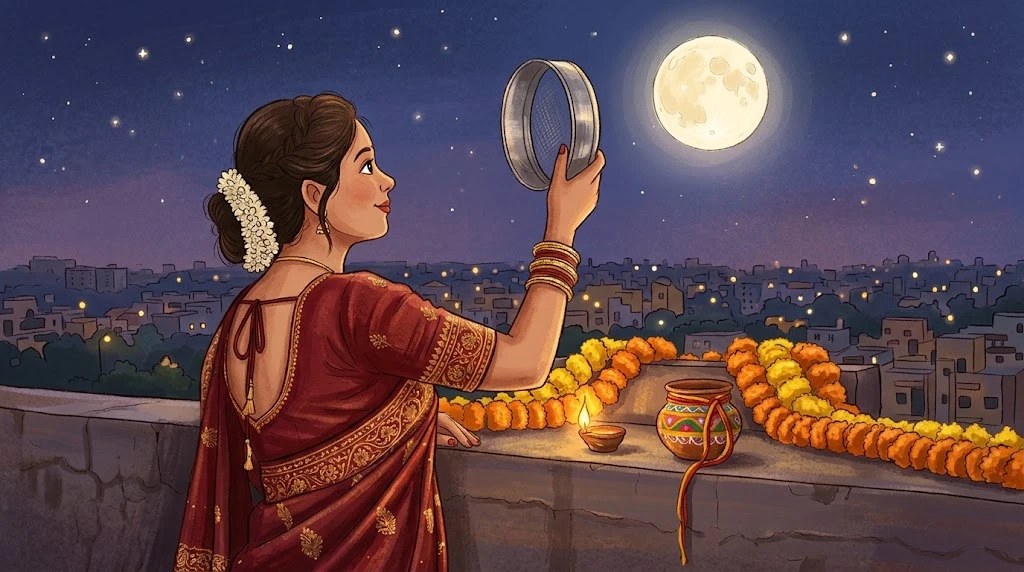
चन्द्रोदय पर (इस पृष्ठ के ऊपर नई दिल्ली का चन्द्रोदय समय दिखता है) छत या खुले आँगन में जाएँ। थाली में छलनी, दीपक, करवा और जल रखें। छलनी में दीपक रखकर उसके पार चाँद को देखें, फिर उसी छलनी से पति के मुख को देखें। करवे से चन्द्र को जल (कई घरों में कच्चा दूध मिलाकर) का अर्घ्य दें, अक्षत-फूल चढ़ाएँ और पति की लंबी आयु की प्रार्थना करें। फिर पति करवे से पत्नी को जल का पहला घूँट पिलाता है और मिठाई का पहला कौर खिलाता है — यहीं व्रत खुलता है।
व्रत खोलने के बाद सास (या घर की किसी बड़ी सुहागिन) के पैर छूकर उन्हें बाया दें — शृंगार की वस्तुएँ, वस्त्र, मिठाई, फल, मेवे और दक्षिणा; वे अखंड सौभाग्य का आशीर्वाद देती हैं। फिर घर के सब लोग मिलकर भोजन करें। भोजन सात्त्विक हो — प्याज़-लहसुन और तामसिक वस्तुएँ नहीं। अगली सुबह करवे का जल तुलसी या किसी पौधे में डालें और ढक्कन का गेहूँ-चावल पक्षियों को दें या रसोई में मिला दें; करवा घर में रखा या किसी सुहागिन को दिया जाता है।
What you need: a spouted karwa of clay or brass with its lid, a sieve (chhalni), a picture of Chauth Mata (Gauri) or a figure drawn on the wall in red ochre and rice paste, an image or picture of Shiva, Parvati, Ganesh and Kartikeya, a red cloth, roli, mauli (the red thread), unbroken rice, turmeric, wheat, raw milk, water, a ghee lamp, incense, flowers, sweets and fruit, the sixteen items of a married woman's adornment, and the baya for the mother-in-law (a plate with sweets, cloth, fruit, dry fruit and dakshina).
On the day, rise before sunrise, bathe, and eat the sargi your mother-in-law has given; it is the first and last meal of the fast. Then take the vow: 'I keep the waterless fast of Karwa Chauth for my husband's long life, health and unbroken good fortune, and I will break it at moonrise after offering arghya to the Moon.' Married women keep this fast; in many homes girls whose marriage has been fixed keep it too.
Take neither food nor water through the day; this is what makes the fast hard, and what gives it its standing. Women who are pregnant, unwell or very old may take fruit or water; a vrat is kept with faith, not with stubbornness. Dress in the sixteen adornments during the day, in red, pink or maroon, with bangles, bindi, sindoor and mehndi; black and white are avoided. Keep away from heavy work and the sun, take the Lord's name or sing the songs of Chauth Mata.
In the afternoon prepare the place of worship. Spread a red cloth on a low stool and set the images of Gauri, Shiva and Ganesh on it. In many homes a picture is drawn on the wall in ochre, showing Chauth Mata, the moon, the sun, a karwa and women keeping the fast, or a printed picture from the market is put up. There is also the custom of shaping a small Gauri from yellow clay or cow dung and offering her a red chunri and adornments.
Prepare your karwa: fill it with water, put wheat or rice and a sweet in the lid on top, tie mauli around it and draw a swastika or seven dots on it in roli. Each woman has her own karwa. Remember Chauth Mata as you fill it. In some traditions two karwas are kept, one for the arghya and one to be given to the mother-in-law or an elder woman.
Before dusk, around sunset, the women of the house or the neighbourhood sit in a circle for the shared puja. Ganesh is worshipped first, then Gauri and Shiva, with roli, rice, flowers, incense, lamp and an offering of food. Then this katha is told. As it is told, the women pass their puja plates and karwas around the circle seven times, the custom called 'pheri' or 'turning the karwa', and with each round they sing the traditional Karwa Chauth song that lists the rules of the fast and what is allowed.
The mantras, by name: 'Om Gam Ganapataye Namah' for Ganesh, 'Om Umayai Namah' or 'Om Gauryai Namah' for Gauri, 'Om Namah Shivaya' for Shiva, and 'Om Somaya Namah' for the Moon at the time of the arghya. No long japa is required; taking the name with faith is enough. If you wish, read any hymn to Gauri-Parvati.
At moonrise (the moonrise time for New Delhi is shown at the top of this page) go up to the roof or out into the open courtyard. On a plate keep the sieve, a lamp, the karwa and water. Place the lamp in the sieve and look at the moon through it, then through the same sieve look at your husband's face. From the karwa pour the arghya of water (in many homes mixed with raw milk) to the Moon, offer rice and flowers and pray for your husband's long life. Then the husband gives his wife the first sip of water from the karwa and the first bite of a sweet. Here the fast is broken.
After breaking the fast, touch the feet of your mother-in-law (or the eldest married woman of the house) and give her the baya: adornments, cloth, sweets, fruit, dry fruit and dakshina. She blesses you with unbroken good fortune. Then the whole family eats together. Keep the meal sattvik, without onion, garlic or anything heavy. The next morning pour the karwa's water at a tulsi or another plant and give the wheat or rice from the lid to birds or mix it into the kitchen grain; the karwa is kept at home or given to a married woman.
सरगी और चन्द्रमा को अर्घ्यSargi and the moon arghya
सरगी सास की ओर से बहू को दिया जाने वाला व्रत का भोजन है, जो सूर्योदय से पहले, ब्रह्म मुहूर्त में खाया जाता है। इसमें फेनी, मठरी, सेंवई, पराँठा, सूखे मेवे, नारियल, फल और मिठाई होती है — ऐसी चीज़ें जो दिन भर शक्ति दें और प्यास कम लगाएँ। सरगी की थाली में साथ ही सास शृंगार की वस्तुएँ भी देती है — साड़ी या सूट, चूड़ियाँ, बिंदी, सिंदूर, मेहँदी। जिनकी सास नहीं हैं या दूर हैं, उन्हें जेठानी, माँ या कोई बड़ी सुहागिन सरगी देती है। सरगी के साथ पर्याप्त जल पी लें, क्योंकि इसके बाद चाँद तक जल नहीं लिया जाता।
सरगी के बाद दिन निर्जल बीतता है — न अन्न, न जल, न चाय। यही इस व्रत को अन्य व्रतों से अलग करता है। स्त्रियाँ दिन में शृंगार करती हैं, मेहँदी लगाती हैं, और शाम ढलने से पहले नए वस्त्र — प्रायः विवाह की साड़ी या लहँगा — पहनकर पूजा के लिए एकत्र होती हैं। हर स्त्री अपनी थाली और अपना करवा लाती है; करवे में जल भरा होता है और ऊपर ढक्कन में अनाज और मिठाई। घेरे में बैठकर कथा सुनी जाती है, करवा सात बार फेरा जाता है और चौथ माता के गीत गाए जाते हैं।
कार्तिक कृष्ण चतुर्थी का चाँद देर से निकलता है और स्त्रियाँ छत पर टकटकी लगाए उसकी प्रतीक्षा करती हैं। बादल हों तो प्रतीक्षा और लंबी हो जाती है — इसलिए इस पृष्ठ के ऊपर नई दिल्ली का ठीक चन्द्रोदय समय दिया गया है। चाँद दिखने पर स्त्री छलनी में दीपक रखकर उसके पार चाँद को देखती है, और फिर उसी छलनी से पति का मुख देखती है। छलनी का भाव यह है कि चाँद को सीधे नहीं, एक आवरण से देखा जाए, और उसके ठीक बाद पति को देखा जाए — मानो चन्द्रमा की शीतलता और आयु पति पर उतर आए। फिर करवे से चन्द्र को जल का अर्घ्य दिया जाता है, अक्षत और फूल चढ़ाए जाते हैं, और स्त्री चन्द्र देव से पति की दीर्घायु की प्रार्थना करती है।
अर्घ्य के बाद पति अपनी पत्नी को करवे से जल का पहला घूँट पिलाता है और मिठाई का पहला कौर खिलाता है — यही व्रत खुलने का क्षण है, और इसीलिए यह दिन दम्पति का दिन माना जाता है। कई घरों में पति इस अवसर पर पत्नी को उपहार देता है। इसके बाद स्त्री सास के पैर छूकर बाया देती है, आशीर्वाद लेती है, और तब परिवार भोजन करता है। जिस स्त्री को चाँद न दिखे, वह चन्द्रोदय समय के बाद चाँद की दिशा में, या पूजा में रखे चन्द्र के चित्र को अर्घ्य देकर व्रत खोल सकती है — यह बात नीचे प्रश्न-उत्तर में विस्तार से है।
The sargi is the meal of the fast that a mother-in-law gives her daughter-in-law, eaten before sunrise in the brahma muhurta. It has feni, mathri, vermicelli, parantha, dry fruit, coconut, fruit and sweets: foods that give strength through the day and do not bring on thirst. With the sargi plate the mother-in-law also gives the items of adornment, a saree or suit, bangles, bindi, sindoor and mehndi. A woman whose mother-in-law is no more, or lives far away, receives sargi from her husband's elder brother's wife, her own mother or any elder married woman. Drink plenty of water with the sargi, because after it no water is taken until the moon.
After the sargi the day passes without water: no food, no water, no tea. This is what sets the fast apart from every other. Through the day the women dress and have mehndi put on, and before evening they put on new clothes, often the wedding saree or lehenga, and gather for the puja. Each woman brings her own plate and her own karwa, filled with water, with grain and a sweet in the lid. Sitting in a circle they hear the katha, pass the karwa around seven times and sing the songs of Chauth Mata.
The moon of Kartik Krishna Chaturthi rises late, and the women wait on the roofs with their eyes on the sky. If there are clouds the wait grows longer, which is why the exact moonrise time for New Delhi is given at the top of this page. When the moon appears, the woman sets a lamp in her sieve and looks at the moon through it, then through the same sieve at her husband's face. The sense of the sieve is that the moon is seen not directly but through a veil, and the husband is looked at right after, as if the Moon's coolness and length of days were passing on to him. Then the arghya of water is poured to the Moon from the karwa, rice and flowers are offered, and the woman prays to the Moon for her husband's long life.
After the arghya the husband gives his wife the first sip of water from the karwa and the first bite of a sweet. This is the moment the fast is broken, and it is why the day is thought of as the couple's own. In many homes the husband gives his wife a gift at this point. The woman then touches her mother-in-law's feet, gives the baya and takes her blessing, and only then does the family eat. A woman who cannot see the moon may break the fast after the moonrise time by offering arghya in the moon's direction, or to the picture of the Moon kept in the puja; this is explained in the questions below.
महत्व और फलMeaning and fruit
परंपरा में करवा चौथ का व्रत पति की दीर्घायु, आरोग्य और दम्पति के अखंड सौभाग्य के लिए किया जाता है। कथा का संदेश स्पष्ट है — व्रत में बहाना या छल नहीं चलता, झूठे चाँद से काम नहीं बनता; पर जो अपनी भूल मानकर धैर्य से फिर पूरी विधि से व्रत करती है, उसे देवी सब लौटा देती हैं। वीरावती का एक वर्ष का धीरज ही उसकी वास्तविक पूजा था। इस व्रत में सास-बहू का बंधन भी है — सरगी सास देती है, बाया बहू देती है — और इसी से यह पर्व पूरे कुटुम्ब को जोड़ता है।
व्रत का केन्द्र चन्द्रमा है, जो मन, भावना, जल और आयु का कारक है, और इसकी देवी गौरी-पार्वती हैं, जो कठिन तप से प्राप्त अखंड दाम्पत्य की प्रतीक हैं। एक दिन का निर्जल संयम मन को साधता है, और छलनी से पति को देखना इस बात की याद दिलाता है कि दाम्पत्य धैर्य और एक-दूसरे की रक्षा से चलता है। जिन स्त्रियों की कुंडली में चन्द्र या शुक्र कमज़ोर हो, या सातवें भाव पर पीड़ा हो, उनके लिए यह व्रत विशेष बताया जाता है; पर वास्तव में यह हर सुहागिन का उत्सव है।
By tradition the Karwa Chauth fast is kept for the husband's long life and health and for the couple's unbroken good fortune. The message of the story is plain: there is no room in a vrat for excuses or trickery, and a false moon does not work; but the woman who owns her mistake and keeps the fast again in full, with patience, has everything returned to her by the Goddess. Veeravati's year of steadfastness was her real worship. The fast also binds mother-in-law and daughter-in-law, one giving the sargi and the other the baya, and in this way the festival joins the whole family.
At the centre of the fast is the Moon, the graha of the mind, of feeling, water and life-span, and its goddess is Gauri-Parvati, the symbol of a marriage won and held through hard tapas. One day of waterless restraint disciplines the mind, and looking at the husband through the sieve is a reminder that a marriage runs on patience and on protecting each other. Women whose kundli has a weak Moon or Venus, or an afflicted seventh house, are said to gain most from this fast; but in truth it is the festival of every married woman.
आरतीAarti
कथा के बाद चौथ माता की आरती गाई जाती है — अधिकांश घरों में गौरी की आरती 'जय अम्बे गौरी' और उसके साथ गणेश जी की आरती 'जय गणेश देवा'; कुछ घरों में शिव आरती 'ॐ जय शिव ओंकारा' भी। चन्द्रोदय पर अर्घ्य के बाद चन्द्र देव को हाथ जोड़कर प्रणाम किया जाता है। आरती के बाद करवे की मिठाई और नैवेद्य का प्रसाद सबको बाँटें।
After the katha the aarti of Chauth Mata is sung; in most homes this is the Gauri aarti 'Jai Ambe Gauri', followed by the Ganesh aarti 'Jai Ganesh Deva', and in some homes the Shiva aarti 'Om Jai Shiv Omkara' as well. At moonrise, after the arghya, the Moon is saluted with folded hands. After the aarti, share the sweet from the karwa and the offered food as prasad.
कब पढ़ेंWhen to read
यह कथा करवा चौथ की शाम को, सूर्यास्त के आसपास, स्त्रियों की सामूहिक पूजा में करवा फेरते हुए सुनी जाती है — चन्द्रोदय और अर्घ्य से पहले।This katha is heard on the evening of Karwa Chauth, around sunset, in the women's shared puja while the karwa is passed round, before moonrise and the arghya.
कुंडली मेंIn your kundli
करवा चौथ का ग्रह चन्द्रमा है — कुंडली में मन, भावना, जल, माता और आयु का कारक — और इसकी देवी गौरी शुक्र से जुड़ी हैं, जो विवाह, दाम्पत्य और स्त्री के सौभाग्य का ग्रह है। जब कुंडली में चन्द्र क्षीण या पाप ग्रहों से पीड़ित हो, शुक्र नीच का हो, या सातवाँ भाव और उसका स्वामी कमज़ोर हो, तब इस व्रत का विशेष महत्व बताया जाता है। आप इसी साइट पर अपनी कुंडली बनाकर अपने चन्द्र और शुक्र की स्थिति, सातवें भाव की दशा और चल रही महादशा देख सकते हैं।The graha of Karwa Chauth is the Moon, which in the kundli stands for the mind, feeling, water, the mother and life-span, and its goddess Gauri is linked to Venus, the graha of marriage, partnership and a woman's good fortune. The fast is said to matter most when the Moon is weak or afflicted by malefics, when Venus is debilitated, or when the seventh house and its lord are weak. You can build your kundli on this site and check the state of your Moon and Venus, your seventh house, and the mahadasha now running.
ग्रह: Grahas: चन्द्रMoon, शुक्रVenus
अपनी कुंडली में देखेंCheck it in your kundliप्रश्नोत्तरQuestions people ask
- करवा चौथ का व्रत कब खोला जाता है? चाँद न दिखे तो क्या करें?When is the Karwa Chauth fast broken? What if the moon cannot be seen?
- व्रत चन्द्रोदय के बाद खुलता है — छलनी से चाँद और पति को देखकर, चन्द्र को अर्घ्य देकर और पति के हाथ से जल का पहला घूँट लेकर। नई दिल्ली का चन्द्रोदय समय इस पृष्ठ के ऊपर दिखता है। बादल हों और चाँद न दिखे तो चन्द्रोदय समय बीतने के बाद चाँद की दिशा (पूर्व-उत्तरपूर्व) में अर्घ्य दें, या पूजा में रखे चन्द्र के चित्र या चाँदी के सिक्के को अर्घ्य देकर व्रत खोलें। रात बहुत हो जाए तो हठ न करें — श्रद्धा ही व्रत है।The fast is broken after moonrise, once you have looked at the moon and your husband through the sieve, offered arghya to the Moon and taken the first sip of water from your husband's hand. The moonrise time for New Delhi is shown at the top of this page. If clouds hide the moon, offer the arghya in the moon's direction (east-northeast) after the moonrise time has passed, or to the picture of the Moon or a silver coin kept in the puja, and break the fast. If it grows very late, do not be stubborn; faith is the vrat.
- सरगी में क्या खाएँ और व्रत खोलने के बाद क्या खाएँ?What should one eat in the sargi, and after breaking the fast?
- सरगी सूर्योदय से पहले खाई जाती है — फेनी, सेंवई, मठरी, पराँठा, सूखे मेवे, नारियल, फल और मिठाई, और भरपूर जल; बहुत नमकीन या मसालेदार चीज़ें न लें, नहीं तो दिन में प्यास सताएगी। चाँद के बाद पहले पति के हाथ से जल और मिठाई, फिर सात्त्विक भोजन — पूड़ी, सब्ज़ी, खीर या हलवा; प्याज़-लहसुन और तामसिक भोजन नहीं। बहुत भारी भोजन एक बार में न करें, निर्जल दिन के बाद पेट धीरे खोलें।The sargi is eaten before sunrise: feni, vermicelli, mathri, parantha, dry fruit, coconut, fruit and sweets, with plenty of water; avoid anything very salty or spicy, or thirst will trouble you through the day. After the moon, first water and a sweet from your husband's hand, then a sattvik meal of puri, vegetables and kheer or halwa, without onion, garlic or heavy food. Do not eat a very large meal at once; after a waterless day, let the stomach open slowly.
- मासिक धर्म, गर्भावस्था या बीमारी में करवा चौथ का व्रत कैसे रखें?How is Karwa Chauth kept during periods, pregnancy or illness?
- मासिक धर्म में व्रत रखा जा सकता है — उपवास और मन में प्रार्थना जारी रखें, पर पूजा-स्थल, करवे और मूर्ति को स्पर्श न करें; कथा सुनें और आपकी ओर से पूजा और अर्घ्य घर की कोई और सुहागिन करे, या दूर से चाँद देखकर अर्घ्य दे दें। व्रत टूटता नहीं। गर्भवती और रोगी स्त्रियाँ निर्जल न रहें — फल, दूध और जल लें और शेष विधि वैसी ही रखें; चौथ माता श्रद्धा देखती हैं, कष्ट नहीं चाहतीं।The fast can be kept during periods: keep the fast and your prayers, but do not touch the puja place, the karwa or the image; hear the katha, and let another married woman of the house do the puja and arghya on your behalf, or offer the arghya yourself from a distance when the moon is seen. The vrat is not broken. Pregnant women and those who are unwell should not go without water; take fruit, milk and water and keep the rest of the method the same. Chauth Mata looks at faith; she does not want suffering.
- क्या पहला करवा चौथ मायके में ही रखना ज़रूरी है? अविवाहित कन्याएँ रख सकती हैं?Must the first Karwa Chauth be kept at the parents' home? Can unmarried girls keep it?
- पहला करवा चौथ मायके में रखने की रीत बहुत घरों में है — कथा में वीरावती भी मायके में थी — पर यह नियम नहीं, लोक-परंपरा है; ससुराल में रखें तो भी व्रत पूरा है। जिन कन्याओं का विवाह तय है या जो मन से किसी को वर मान चुकी हैं, वे भी कई क्षेत्रों में यह व्रत रखती हैं; तब चाँद को अर्घ्य देकर स्वयं जल ग्रहण करें। कुछ परंपराओं में अविवाहित कन्याएँ चाँद के बदले तारे देखकर व्रत खोलती हैं।Keeping the first Karwa Chauth at the parents' home is the custom in many families, and Veeravati in the story was at her parents' house too, but it is a folk tradition, not a rule; the fast kept at the husband's home is just as complete. Girls whose marriage is fixed, or who have chosen their groom in their heart, keep this fast in many regions; they offer the arghya to the moon and take water themselves. In some traditions unmarried girls break the fast at the sight of the stars instead of the moon.
साथ में पढ़ेंRead alongside
 व्रत कथाVrat Kathas
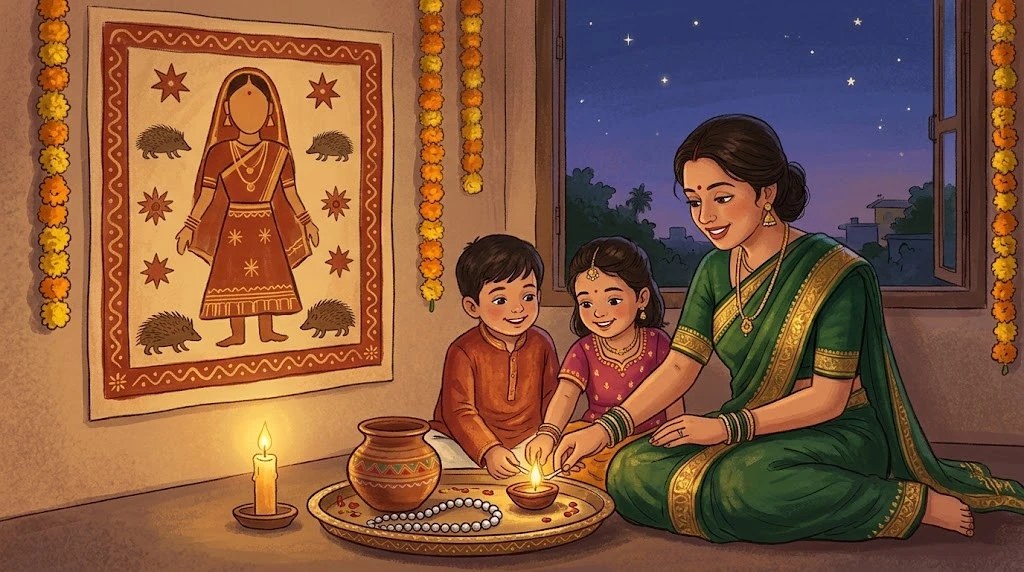
अहोई अष्टमी व्रत कथा
Ahoi Ashtami Vrat Katha
कार्तिक कृष्ण अष्टमी का संतान-रक्षा व्रत — साहूकारनी, स्याहु के बच्चे और सात पुत्रों की कथा, अहोई माता का चित्र, स्याहु माला और तारों को अर्घ्यThe Kartik Krishna Ashtami fast for one's children: the moneylender's wife, the syahu's cub and the seven sons, the Ahoi image on the wall, the syahu mala and the arghya to the stars
सोमवार व्रत कथा
Somvar Vrat Katha
भगवान शिव का सोमवार व्रत — साहूकार और उसके पुत्र की कथा, व्रत विधि और उद्यापनThe Monday fast for Lord Shiva: the moneylender's son, how to keep the fast, and the udyapan